.png)
By Elsa d'Hane, Anthropologist at New Possible
'We asked 100 people...' started life as a quiz for the Out Of Office podcast, using data collected via a representative consumer panel. It later evolved into a series of quick insight posts for LinkedIn. But as more of these posts went out, we started to wonder whether there was a bigger story behind the numbers.
At first glance, the questions are very simple. How many cups of coffee do you drink during the workday? If someone brings snacks to work, what’s your move? How much time do you spend replying to and sending emails?
They are the kind of questions that might prompt a quick scroll, a smile of recognition or a ‘that’s definitely me’ reaction. But put together, the answers reveal something much more interesting. Looking at the everyday experiences of UK workers, one theme came through strongly: our relationships with colleagues matter. And sometimes, it is the smallest, most routine moments at work that create the space for those relationships to develop.
It starts with coffee
When this series began, one of the first questions we asked was: 'How many cups of coffee do you drink in the workday?'
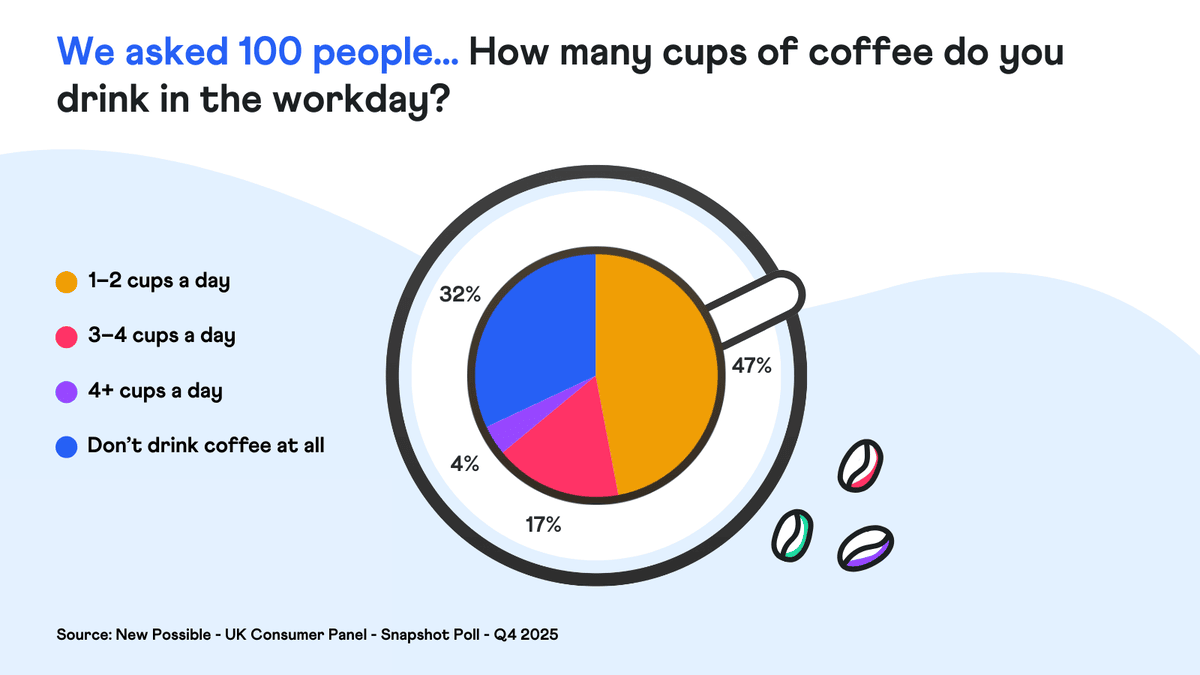
Of the 100 people we asked, the largest group (47%) said they drink between 1-2 cups a day. That might not sound particularly surprising as, after all, coffee is practically part of the working day for many people. Also, this was a UK-based survey, so it's worth remembering that the 32% of people who said they don’t drink coffee may well have another preferred hot drink. Tea anyone?
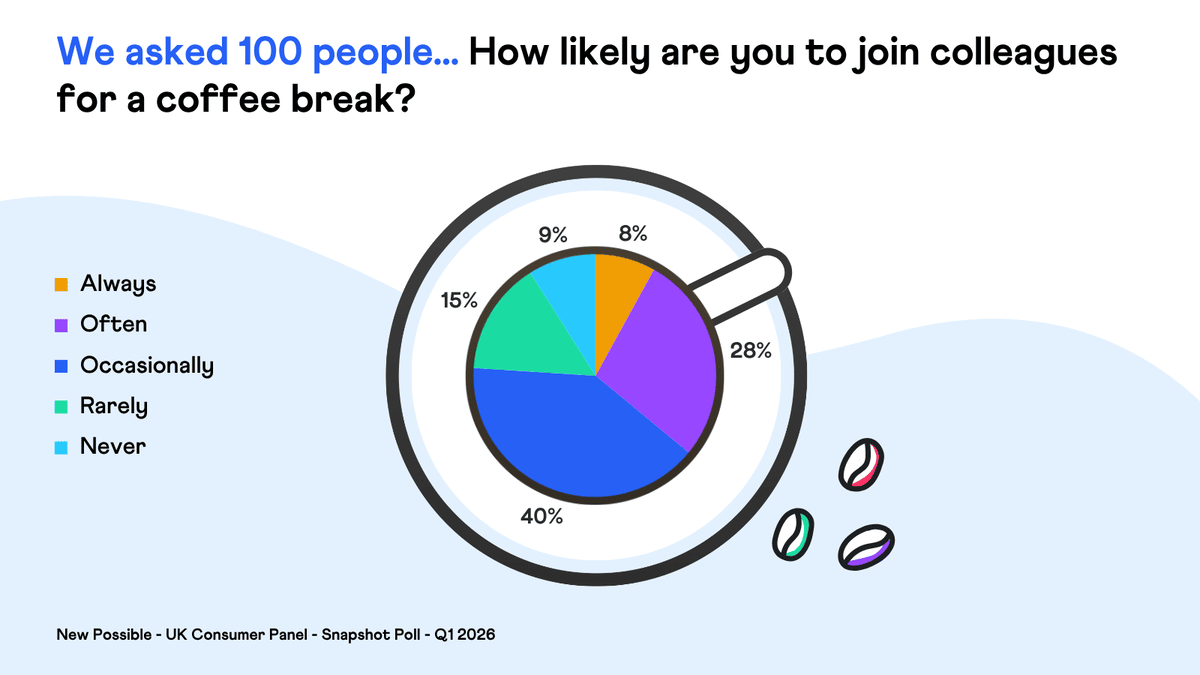
More interestingly, when we asked people about having coffee with colleagues, 76% said they would occasionally, often or always choose to do so compared to the 24% who selected rarely and never. Therefore, maybe the coffee break isn’t really about the coffee. It is about what happens while you’re waiting for the kettle to boil.
The five-minute conversation about the weekend. The quick catch-up about a project. The ‘how are you?’ which somehow ends up covering someone’s holiday plans, a new TV series or the latest gossip.
These moments might not appear in the calendar, but they're still part of the working day – and they can be surprisingly important.
The kitchen might be the most important meeting room
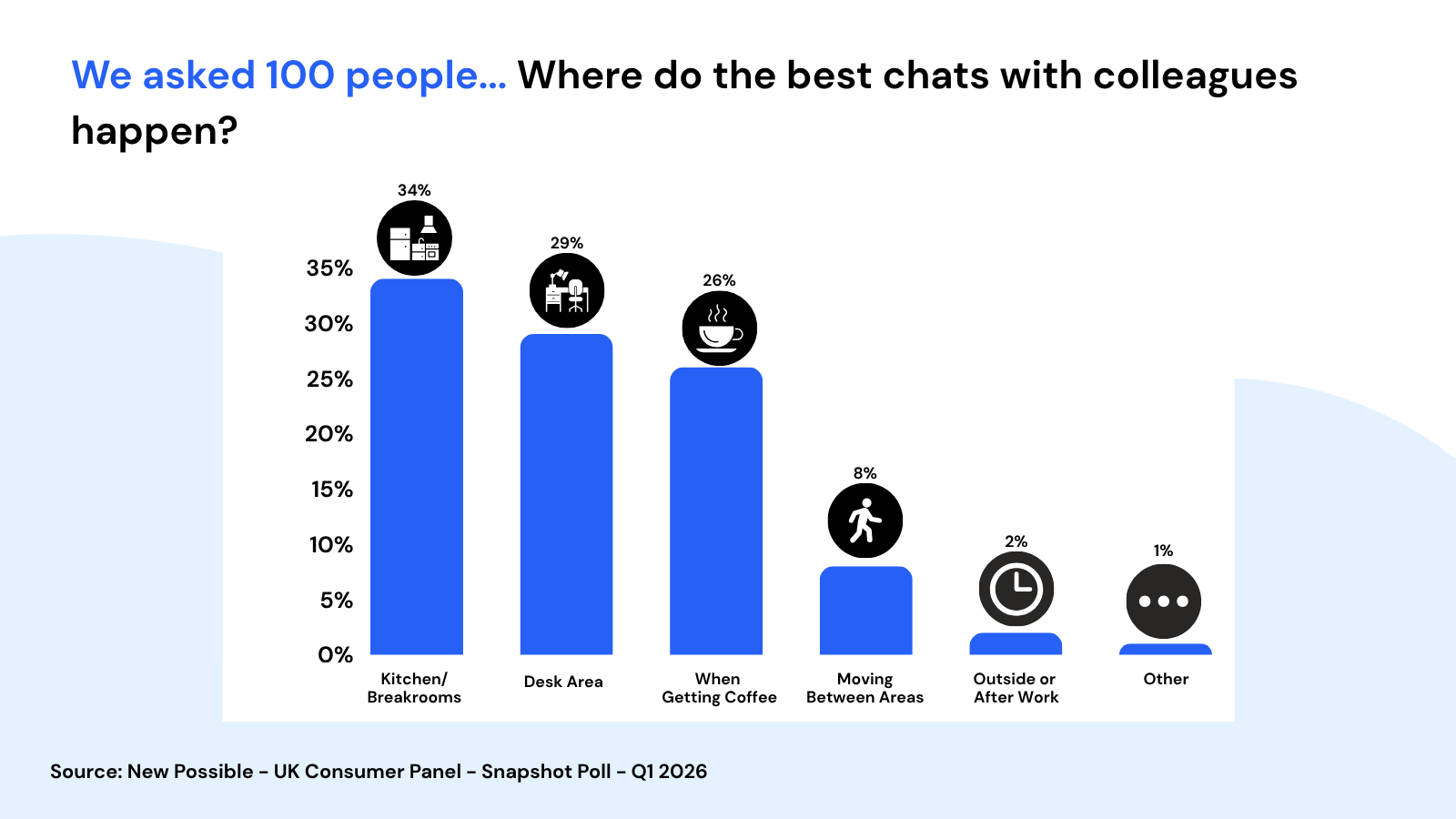
We also asked people where they have the best chats with colleagues - and the kitchen and breakroom spaces came out on top. Grabbing a coffee ranked highly too. This is revealing because these are spaces designed for something other than work.
There is no agenda. No presentation. No Teams link. No requirement to contribute.
Informal spaces give people an opportunity to interact without pressure or the structure of a formal meeting. They create those little moments where conversations can happen naturally. A quick chat in the kitchen might turn into a useful idea, while a five-minute break might simply make someone’s day feel a little more connected. These interactions are so ordinary that we barely notice them. But collectively, they can have a big impact on how work feels.
Fancy a brew?
The free-text responses also add another layer of depth. When we asked people, 'What’s a phrase you hear every day at work?', 7% gave answers along the lines of 'fancy a brew?' or simply 'coffee?'. Another 13% mentioned small talk phrases such as 'How was your weekend?' or comments about the weather. These are not exactly ground-breaking conversations, but they are how relationships are maintained.
In many ways, these everyday exchanges are the social equivalent of routine maintenance. They may seem insignificant on their own, but they help keep people connected. They create opportunities for colleagues to check in with one another, build familiarity and establish trust over time. The fact that coffee breaks and kitchen conversations ranked so highly is probably no coincidence. Those spaces provide the setting for the seemingly small interactions that make workplaces feel more human.
The social side of work
When we asked people, 'What do you like best about working with your colleagues?', social interaction came out on top, with 40% choosing it. That result brings the coffee data into a much bigger picture.
People do not just value their colleagues because they work together. They value the social connection that comes with being part of a team. As humans, we naturally crave connection, conversation and a sense of belonging. Work is a significant part of our lives, so it makes sense that our relationships at work play an important role in how we experience it.
A coffee break will not solve every workplace challenge, but it can create important moments of connection.
This theme also connects with our latest anthropology article, where we looked at the words employees use to describe their workplace. The top word across promoters, passives and detractors was 'friendly'. That finding is particularly revealing. Even employees who rated their organisation poorly and described their workplace as busy, stressful or chaotic were still most likely to describe it as friendly. In other words, people may not always be happy with workloads, processes or organisational decisions, but they still place enormous value on the relationships they have with the people around them.
The same pattern appears in our 2026 What Workers Want survey. Among respondents across the UK, one of the strongest reasons for staying with a current employer was having good relationships with colleagues. In fact, 25% of respondents identified positive colleague relationships as a key driver of retention. Taken together, these findings point to a simple but important truth: workplace experience is not just shaped by policies, benefits or productivity. It is shaped by people. The relationships employees build with colleagues often become the reason they enjoy coming to work, remain engaged and choose to stay, even when other aspects of the job are less positive.
But these interactions are also signals. They tell us something about whether people feel connected, whether relationships are forming and whether the workplace feels like somewhere people want to be.
So, what can a coffee break actually do?
A coffee break has the potential to spark new ideas, strengthen relationships, lay the foundations for a healthy workplace culture or simply provide a much-needed caffeine boost.
The value is not really in the coffee itself. It is in the opportunity it creates for people to connect. The conversations that happen while waiting for the kettle to boil or walking to the café might seem trivial, but they help build trust, familiarity and a sense of belonging. Over time, those small moments can contribute to a stronger, more connected workplace culture.
So, next time someone asks if you fancy a coffee, say yes. You might be doing a little bit more to build the culture around you. Or you might simply be having a five-minute break. Either way, those moments matter.
About New Possible
New Possible is the people insight platform that’s committed to your success. We work with a range of sectors to provide clear, actionable, and benchmarkable insights across the employee journey. Read about our mission, or book a demo to learn more.