By Elsa d'Hane, Social Anthropologist at New Possible
Just three words can reveal more about a workplace than you think. A quick word association reveals insights into the organisational structure, relationships, and culture of a workplace. By examining the frequency of words, and applying anthropological research techniques, in this article we read between the lines and uncover the stories within employee language.
Anthropology has traditionally relied on immersion to understand culture. Through participant observation, shared environments, and everyday interactions, anthropologists attempt to interpret how people create meaning within social groups. However, in organisational settings, direct immersion is not always possible. Rather than viewing language as a neutral tool for communication, anthropologists often treat it as a reflection of how people understand their social world. Contemporary workplaces are increasingly assessed through surveys and digital communication, and within this data, language is culturally revealing. The words people use to describe their workplace can offer insight into how culture is emotionally experienced, negotiated and understood.
In this article, we explore workplace culture through employee language collected from multiple organisations over a 12-month period (check our Benchmark here). Employees were asked to describe their workplace in three words, with responses segmented according to employee Net Promoter Score (eNPS) categories: promoters, passives, and detractors. Using this data, we look at the frequency of the language used as well as the recurring words and the patterns that emerge across these groups.
Repeated language reflects more than individual opinion; it reveals shared observations and collective emotional responses. By examining which words appear most often, we use workplace language as a form of cultural evidence, offering a snapshot insight into the experiences of employees across the UK and Europe.
Interpreting Workplace Culture Through Words
The frequency analysis reveals several striking patterns across all three eNPS categories. Most notably, ‘friendly’ appears as the most frequently used word among promoters, passives and detractors alike. Given that the dataset combines responses from multiple organisations across the UK over a twelve-month period, this suggests that employees broadly perceive workplace culture as socially positive, regardless of overall satisfaction levels. Other recurring words such as ‘support’, ‘fun’, ‘comfort’ and ‘collaborative’ also appear consistently within the top responses across groups. The repetition of these relational words is significant because it reflects the importance employees place on social interaction and interpersonal experiences within their workplace culture. Rather than describing organisations through technical or structural terms, employees define work through relationships and emotional atmosphere.
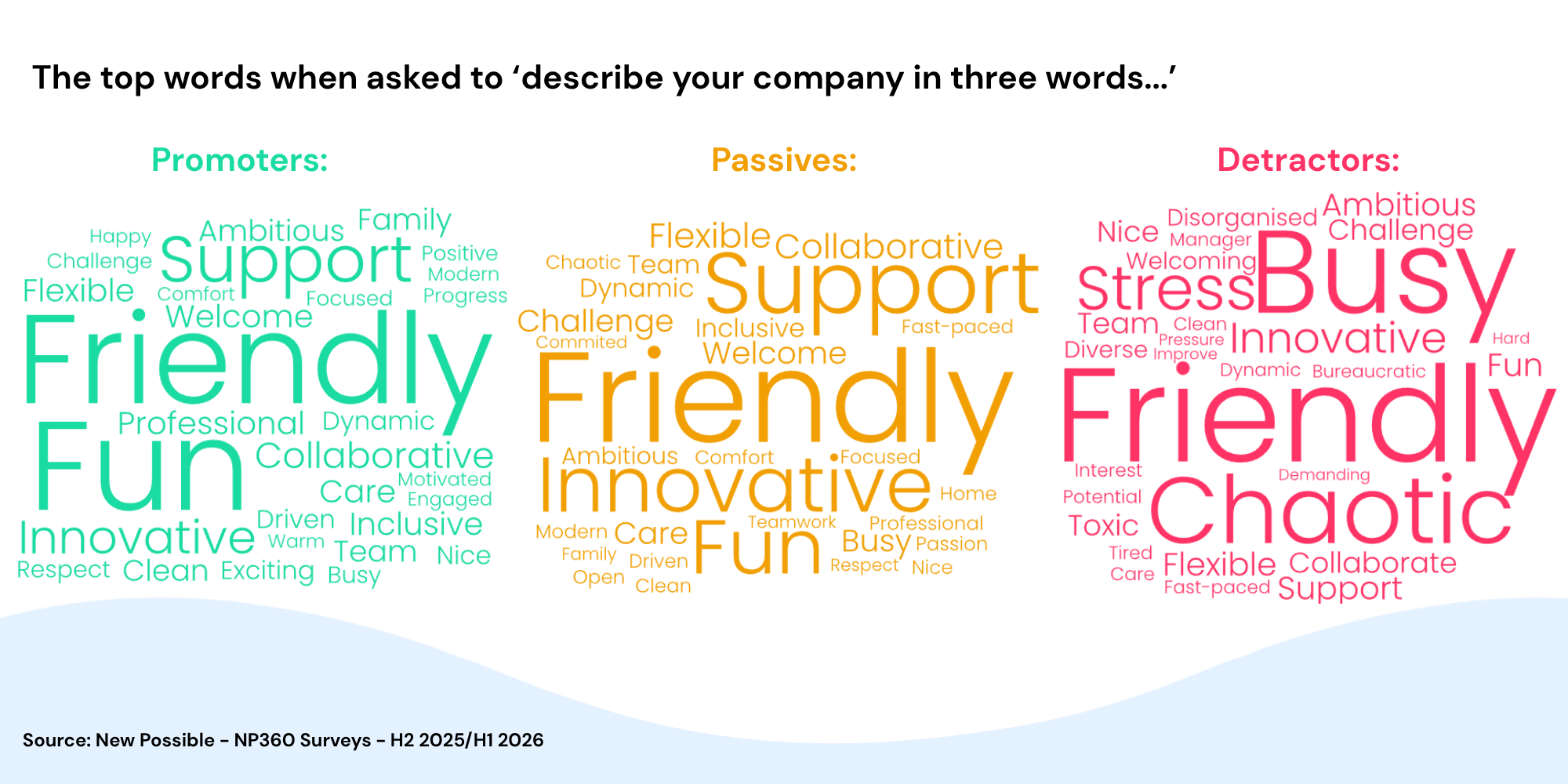
At the same time, each category reveals distinct emotional tones. Promoters tend to use emotionally invested language such as ‘family’, ‘respect’, ‘motivated’, and ‘engaged’, suggesting a stronger sense of identification with the organisational culture. The appearance of ‘family’ and ‘respect’ is particularly interesting because these words imply mutual recognition and a sense of collective belonging rather than simply workplace satisfaction. Anthropologically, this points towards a culture experienced as socially cohesive, where relationships are understood through trust and togetherness.
In contrast, detractors introduce language associated with pressure and fragmentation, including ‘stress’, ‘chaotic’, ‘toxic’ and ‘disorganised’. While promoters describe relationships horizontally through words such as ‘team’, ‘care’ and ‘support’, detractors use the word ‘manager’. This difference is significant because it suggests contrasting experiences of workplace relationships: one grounded in collective belonging and another shaped by hierarchy and authority. This shift in relational language to managerial language indicates a level of emotional distance, a lack of trust or feelings of disconnection within the organisational structure.
Comparative analysis also reveals how certain workplace terms carry unstable or contested meanings. Words such as ‘innovative’, ‘dynamic’ and ‘challenge’ appear across all three categories, yet their emotional implications differ depending on an employee’s experience. For some, innovation and challenge may represent opportunity, growth or engagement and for others, they may reflect instability, pressure or unrealistic expectations. This demonstrates that workplace language is not fixed or universally understood but shaped through lived social experience. The same organisation can therefore contain multiple cultural realities which are revealed through the differing emotional meaning attached to the same words.
Final Comments
Workplace language can reveal important insights into organisational culture, even through something as brief as a three-word survey response. While anthropology has traditionally relied on direct immersion and observation to understand culture, recurring workplace language can also act as a form of cultural evidence. The repeated use of words such as ‘friendly’, ‘supportive’ and ‘collaborative’ suggests that relationships and emotional atmosphere are central to how employees experience work across organisations. At the same time, the differences between promoters, passives and detractors show that workplace culture is not experienced the same way by everyone. Promoters often describe work through words connected to belonging and interpersonal experiences. Detractors are more likely to use words linked to hierarchy, pressure and emotional exhaustion. Some words such as ‘innovative’ and ‘challenge’ have different meanings based on employee experience, showing that workplace language is shaped by emotion, social connections and context, rather than fixed definitions.
It is also helpful to analyse these words alongside eNPS and other markers such as Wellbeing, Engagement and Work-Life Balance to put the language into a wider context to get a more insightful and actionable perspective.
Ultimately, language does more than describe workplace culture, it reflects how culture is emotionally lived. By examining recurring words across employee groups, it becomes possible to identify multiple cultural realities existing within the same organisation. Employee language provides a valuable lens for understanding how people experience their work, relationships and belonging in organisations.
About New Possible
New Possible is the people insight platform that’s committed to your success. We work with a range of sectors to provide clear, actionable, and benchmarkable insights across the employee journey. Read about our mission, or book a demo to learn more.
If you’d like to discuss this research further, please email hello@newpossible.io or call 0161 706 0618.