Maybe your surveys take too long to complete. Perhaps employees are suffering from survey fatigue or don’t feel safe answering honestly. It could be that no meaningful action is taken after the survey closes, or that leaders are too busy or unequipped to turn feedback into change. Getting employee surveys wrong can be costly. When you see little or no improvement in results, it can feel easier to give up altogether.
There’s also a damaging cycle that many organisations fall into:
.png)
Without trust and participation, even the best-designed survey can become little more than a box-ticking exercise.
The good news is that all of these challenges can be addressed. With the right approach, employee surveys can be adapted to better fit your organisation’s needs and deliver more valuable insights. They can also be combined with always-on listening approaches, helping you understand how employees are thinking and feeling when it matters most.
Asking the right questions
Having a set of questions that are relevant and actionable is key to a successful employee survey.
A good place to start is by identifying what you want to measure and, just as importantly, why you want to measure it. Being clear about the outcomes you’re looking for will help you design questions that generate useful insights and support informed decision-making. In many cases, the challenge with an existing listening strategy isn't a lack of feedback, but the questions being asked and how they're structured.
Reviewing both the survey questions and the overall survey length can make a big difference to the quality of responses you receive. While it’s important to cover a range of topics, it’s equally important to ask questions that lead to meaningful action. Whether you are sending out an annual survey or a quick pulse survey, make sure every question has a clear purpose and is relevant to the topic and information you want to gather.
Using a mix of rating-scale and free-text questions can help keep surveys efficient, engaging and manageable. One of our favourite questions to ask at New Possible is: ‘Describe your organisation in three words.’ It’s a simple question, but it often produces rich and actionable insights into an organisation’s culture (check out our blog on this topic).
Question design also plays a crucial role in the quality of feedback you collect. For multiple-choice, rating scales and checkbox questions, try to avoid leading questions (e.g. 'How much did you enjoy...?'), as these can influence responses and limit the value of the insights gathered. It’s also worth limiting the number of free-text questions. While open-ended responses can provide valuable detail, they take longer to answer, require more effort from employees and can contribute to survey fatigue.
At New Possible, we can support you with every aspect of question design. Our platform includes a range of ready-to-use surveys, and with the support from our dedicated insight team, we can help you create a survey that targets the areas most important to your organisation.
Expecting too much, too soon
Change takes time and it’s important to set realistic expectations.
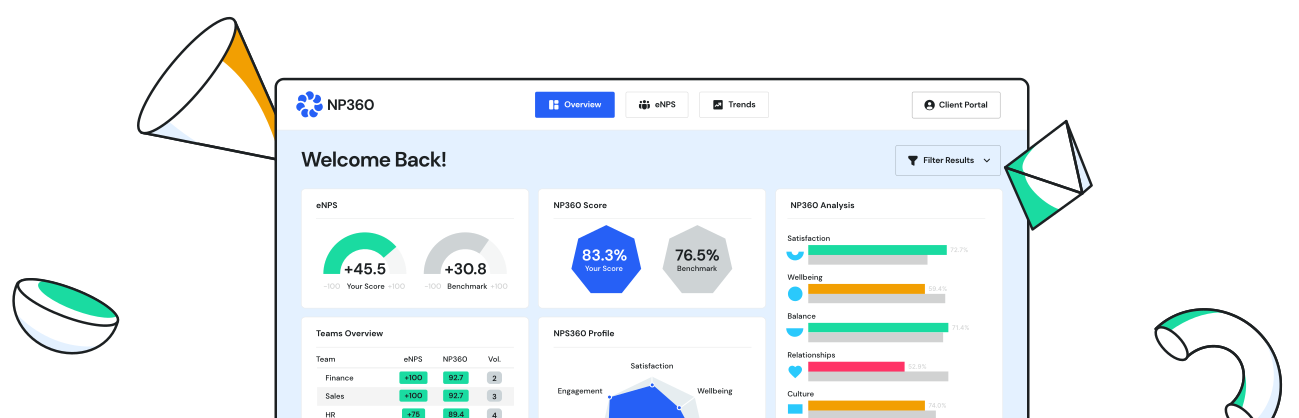
A short survey that combines benchmarkable data, such as eNPS, with free-text responses can provide measurable results and practical suggestions for improvement as well as help answer the 'why'.
Rather than expecting immediate results, allow time for actions to take effect. Running shorter pulse surveys during the year can help you understand how employees are responding to the changes you’ve made and whether you’ve been moving in the right direction.
Include additional listening channels
Consider adding complementary channels to capture employee voice.
Suggestion boxes and focus groups can provide more immediate insights into how changes are being received. At New Possible, we offer a scalable Focus Group feature that makes it easy for teams or entire organisations to dive deeper into topics and validate ideas in real time. This feature works particularly well after a survey to understand the reasons behind answers.
We also offer TrustChat, an anonymous messaging service that allows employees to share ideas, concerns and feedback safely and confidentially. Both options work particularly well for deskless and remote employees because they can participate simply by clicking a link or scanning a QR code.
Turning feedback into action
Your surveys may already be collecting valuable data, but the information might not be in the right format to drive meaningful action or measure progress effectively.
By reviewing your questions, setting realistic expectations and combining surveys with other feedback methods, you can gain deeper insights and uncover new ways to tackle challenges head-on.
Sometimes the biggest improvements in employee listening come from small changes in approach.
Whether you’re looking to improve your surveys, introduce always-on feedback, or run large-scale focus groups, New Possible can help you build an employee listening strategy that drives meaningful change. Read more about our mission or book a demo.