New Possible’s British HR Awards sets out to discover and celebrate the teams and individuals who are truly passionate about delivering a world-class people experience.
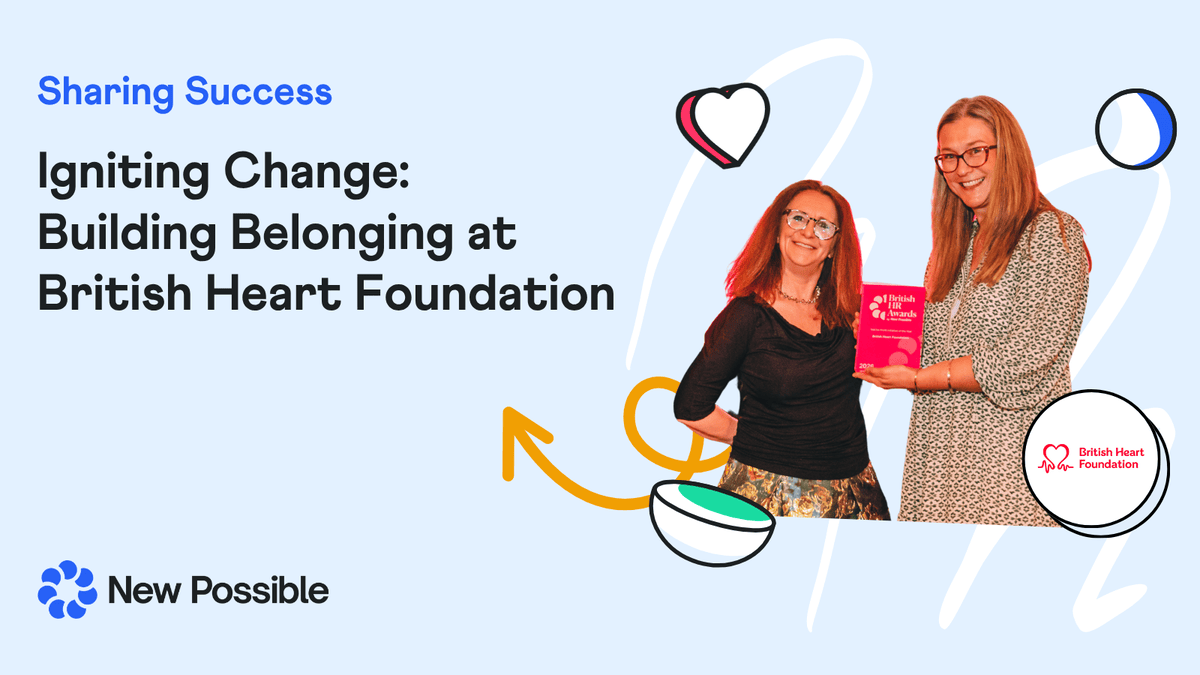
Continuing with our Sharing Success series, we interview British HR Awards 2026 Winners to shine a light on the inspiring projects that are improving workplaces across the UK and beyond. In this article we chat with Sarah Danes from British Heart Foundation, winners of the ‘Diversity & Inclusion Initiative of the Year’ and ‘Not for Profit Initiative of the Year’ categories.
Introducing Sarah Danes
Sarah is the Director of Wellbeing, Safety and Inclusion at the British Heart Foundation, where she leads the organisation-wide strategy for colleague wellbeing, safety, and equity, diversity and inclusion (EDI). Her focus is on creating an environment where every colleague and volunteer feels valued, supported, and able to thrive.
Sarah shared: "A core part of my role has been contributing to the development and delivery of Igniting Change, our cross-organisational EDI strategy. This was shaped by a small group of senior leaders, led by our Chief Executive, working collectively to define both the ambition and how we would deliver it in practice. Within that, I’ve been accountable for leading the colleague-focused elements of the strategy.”
About British Heart Foundation
The British Heart Foundation is the UK’s largest independent funder of cardiovascular research, turning donations into lifesaving discoveries for people with heart and circulatory diseases. Their vision is a world where hearts beat healthier for longer, driven by science that prevents illness, transforms care and gives families more time together. Across British Heart Foundation, their 4,000 colleagues and 20,000 volunteers are united by a powerful people promise: meaningful work, supportive leadership and a culture that puts wellbeing at the heart of what we do.
Igniting Change: Building Belonging at BHF
Over the past three years, the British Heart Foundation (BHF) has delivered a significant transformation in employee experience through Igniting Change - its organisation-wide Equity, Diversity and Inclusion (EDI) strategy. Developed to address inequalities both within the organisation and across the communities affected by heart and circulatory diseases, the strategy has driven measurable cultural, behavioural, and operational progress across the charity.
Recognising that heart and circulatory diseases disproportionately impact people based on factors such as ethnicity, disability, income, geography, and gender, BHF sought to ensure its internal culture reflected the same commitment to fairness and inclusion that underpins its external mission.
What prompted the British Heart Foundation to develop the Igniting Change strategy, and what gaps or challenges were they most determined to address?
Sarah answered: “Igniting Change was shaped by a clear and compelling insight: heart and circulatory disease is closely linked to inequality. Factors such as where people live, their income, ethnicity, gender and disability can all influence both risk and outcomes.
As an organisation committed to improving heart health for everyone, we recognised that we needed to look inward as well as outward. If we were serious about tackling health inequalities, our own culture, systems and behaviours had to reflect that same ambition.
The challenges we set out to address were both structural and cultural. Structurally, we needed to remove barriers in areas such as recruitment, progression and policy design. Culturally, we wanted to strengthen a sense of belonging and ensure colleagues from all backgrounds could see opportunities to succeed at BHF.
Importantly, this was never intended to be a collection of standalone initiatives. Igniting Change was designed as a whole-organisation strategy — embedding EDI into leadership accountability, data-driven decision making, colleague experience and even how we approach research and external impact.”
Inclusive Policies and Support
To create a more equitable workplace experience, BHF introduced several new people policies and support mechanisms, including:
- Equalised parental and partner leave, providing all parents with 12 weeks’ paid leave
- Launched Support Leave - a flexible, needs led provision used by 20% of colleagues in its first year
- New Transitioning at Work guidance for colleagues and volunteers
- A Disability & Accessibility Information Hub offering improved access to specialist support
- Inclusive communication guidance through its “11 Simple Steps for Accessible Content”
Improving Recruitment Fairness and Representation
BHF strengthened equity throughout its recruitment processes by introducing:
- Anonymous CV screening
- Gender bias decoding tools
- Flexible working options from day one
- Inclusive advertising standards
These changes contributed to an increase in job offers made to ethnically minoritised candidates, rising from 15% to 20% YoY.
Supporting Diverse Talent and Leadership Progression
To improve progression opportunities and representation at leadership level, BHF launched several targeted development initiatives, including:
- The Aspiring Leaders Programme supporting ethnically minoritised colleagues
- A career re-entry partnership designed to improve inclusion within research roles
- Funding for the Black in Cardio network supporting underrepresented researchers
- Mandatory EDI objectives embedded into performance plans for approximately 130 senior leaders
We asked Sarah to tell us more about the Ignite Aspiring Leaders programme and the difference it’s making, Sarah commented:
“The Ignite Aspiring Leaders programme is one of our targeted interventions to support greater equity in career progression, particularly for colleagues from ethnically minoritised backgrounds.
It was developed in response to both data and lived experience, which highlighted that while we were making progress in attracting diverse talent, progression into leadership roles was not happening at the same pace for everyone.
The programme focuses on building confidence, developing leadership capability and helping colleagues navigate their career pathways more effectively. Just as importantly, it provides visibility and sponsorship — reinforcing that diverse talent is recognised, valued and actively supported at BHF.
While it’s one part of a broader, systemic approach, it plays an important role in addressing barriers and strengthening our leadership pipeline. Alongside this, we’ve reinforced accountability by embedding EDI within our Leadership programme, helping to create an environment where inclusion is actively developed, supported and led at every level.”
Using enhanced insight from segmented surveys, listening groups, and EDI dashboards, BHF has delivered targeted actions that have led to notable improvements in employee perceptions:
- Black colleagues agreeing that “people of diverse backgrounds can succeed” increased from 60% to 77%
- Neurodiverse colleagues feeling supported by managers rose from 70% to 82%
- Colleagues experiencing mental ill health feeling fairly treated increased from 82% to 94%
- The organisation’s median gender pay gap reduced to 1.7%
We asked Sarah which policy changes introduced in the last 12 months have had the most immediate or noticeable impact on colleagues’ experiences. She shared:
“Equalising parental and partner leave has been a particularly visible shift — ensuring all parents have access to the same 12 weeks’ paid leave. This has been an important step in promoting fairness and challenging traditional assumptions around caregiving.
We also introduced Support Leave, a flexible and needs-led provision that allows colleagues to take paid time off during significant life moments. Alongside this, the Workplace Adjustment Policy and the Support Needs Working Group have been instrumental in helping colleagues access the support they need more quickly, creating a clearer and more responsive route to practical help.
Alongside this, initiatives such as our Transitioning at Work guidance and the Disability & Accessibility Information Hub have strengthened the support available to colleagues, making it clearer and easier to access the help they need. We also internally launched our Anti-Racism statement, whose implementation has strengthened the work underway to improve recruitment outcomes and, I believe, supported improved engagement survey results for demographic groups that had previously scored lower.
Taken together, these changes have helped shift the day-to-day experience of working at BHF - making it feel more equitable, inclusive and responsive in practice, not just in principle.”
Delivering Lasting Impact
The broader impact of Igniting Change has been significant across employee and volunteer experience:
- 88% of colleagues now believe BHF is a place where people from diverse backgrounds can succeed, up from 77% in 2022
- 78% feel a sense of belonging, compared to 72%
- 71% feel encouraged to fulfil their potential, up from 65%
- 93% of volunteers describe their experience as ‘easy, flexible, and inclusive’
Building on this momentum, BHF recently launched Our People Power, positioning EDI as one of three core organisational “game changers” for the future.
Through Igniting Change, the British Heart Foundation has embedded inclusion more deeply into its culture, leadership, and people practices - creating a workplace where colleagues and volunteers feel supported, represented, and empowered to thrive.
What advice would Sarah give to other organisations looking to create meaningful, measurable change in diversity and inclusion?
“One of the key lessons from our experience is that meaningful change comes from taking a whole-system approach. It’s not about individual initiatives in isolation, but about embedding EDI into how the organisation operates day to day.
Starting with data and listening is critical. Combining insight from colleague surveys with listening groups has helped us understand where disparities exist and take targeted, evidence-based action.
Equally important is focusing on practical change — removing barriers through policy, improving fairness in recruitment, and creating clearer pathways for progression. These are the areas where colleagues most quickly feel the difference.
Accountability also matters. Embedding EDI within our Leadership programme has helped ensure that inclusion is not just talked about but consistently prioritised and acted upon.
Finally, it’s important to recognise that this is ongoing work. Sustaining progress requires continued focus, transparency and a willingness to keep learning and adapting.”
Overall, the judges praised the 'comprehensive changes' with evidence of 'specific improvement for those targeted'.
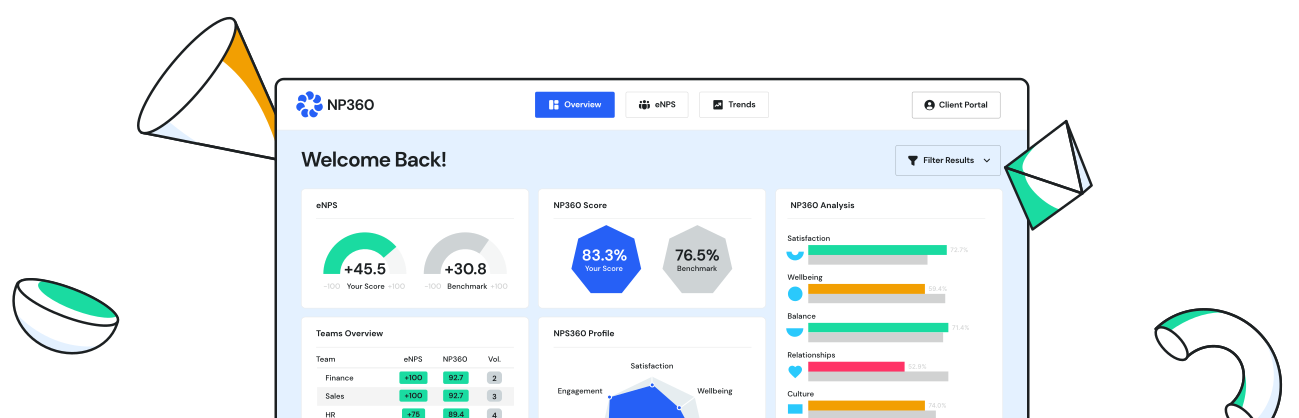
The British HR Awards is powered by New Possible, a people insight platform that's committed to your success. New Possible helps leaders build healthier organisations by providing meaningful insight that can drive real change. Find out more about our mission or book a demo.